SHRM CP Situational Questions How to Choose the Best Answer and Why It Matters
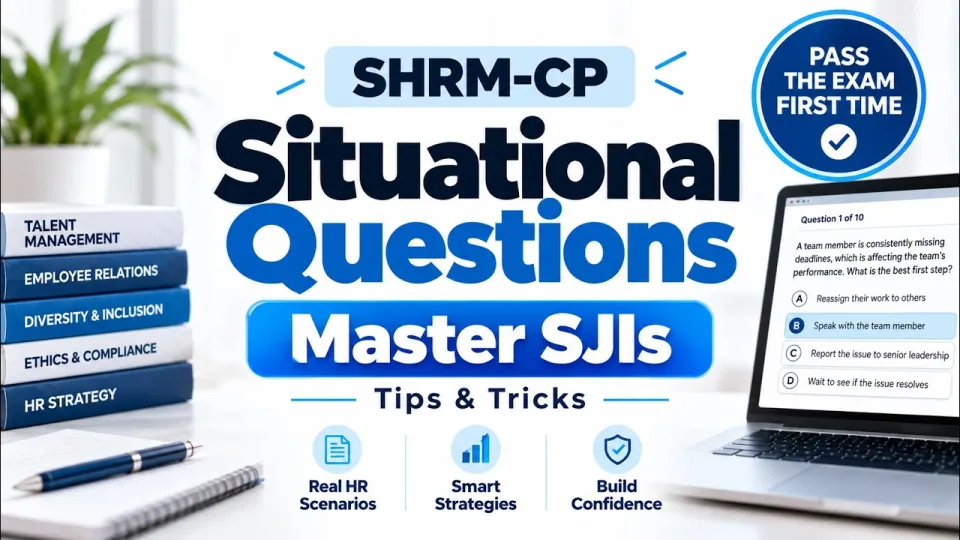
Video: SHRM CP Situational Questions (SJIs) | TIPS TO PICK THE RIGHT ANSWER
· based on the channel PrepSolution
SHRM CP situational questions often present multiple reasonable answers, making it challenging to select the best response. The key to mastering these situational judgment items (SJIs) lies in applying a structured approach that balances HR principles with the scenario's specifics. This article explains how to pick the right answer by focusing on five essential decision checks, recognizing common answer traps, and practicing strategic elimination.
One valuable resource to enhance your preparation is the free SHRM-CP practice questions, which offer realistic scenarios and detailed explanations.
Understanding SHRM CP Situational Questions
SHRM CP situational judgment questions assess your ability to apply HR knowledge in workplace scenarios, focusing on practical problem-solving rather than theoretical recall. These questions typically describe an HR-related situation and ask you to select the most appropriate action from four options.
Unlike straightforward multiple-choice questions, all answer choices may seem reasonable at first glance. The challenge is to determine which response aligns best with SHRM's HR competencies, legal compliance, and organizational policies while effectively addressing the problem.
Five Decision Checks to Identify the Best Answer
To choose the best answer, apply these five decision checks systematically:
- Facts of the Scenario: Analyze the key details and context. Avoid answers that ignore or contradict critical facts.
- Policy and Law: Ensure the response complies with applicable laws and organizational policies.
- Appropriate Escalation: Decide whether the issue requires escalating to higher management or HR specialists and avoid unnecessary escalation.
- HR’s Role: Determine HR’s appropriate involvement without overstepping boundaries or taking over managerial responsibilities.
- People Involvement: Consider who should be involved in resolving the issue to maintain fairness and transparency.
Applying these checks helps filter out options that are legally risky, procedurally incorrect, or operationally impractical.
Distinguishing Between First Step and Most Effective Action
A common challenge in SHRM CP situational questions is recognizing whether the question asks for the next immediate step or the most effective long-term solution.
- First Step: The initial action to begin resolving the issue, often involving fact-finding or preliminary communication.
- Most Effective Action: The response that best addresses the root cause or resolves the conflict comprehensively.
Misinterpreting this can lead to selecting an answer that is either premature or insufficient, so pay close attention to the wording of the question.
Five Common Answer Traps and How to Avoid Them
SHRM CP situational questions often include distractors designed to test your judgment. These traps include:
- Premature Action: Acting before gathering all relevant facts or understanding the situation fully.
- Passive Response: Failing to take necessary action, resulting in unresolved issues.
- Taking Over Manager’s Responsibilities: HR should support but not replace managerial duties.
- Unnecessary Escalation: Escalating minor issues that can be handled at a lower level wastes resources.
- Legally Defective Options: Answers that violate laws or policies, risking compliance problems.
Recognizing these traps requires careful reading and applying the five decision checks.
Practical Tips for Eliminating Wrong Answers
Instead of relying solely on personal workplace experience, test each choice against the scenario’s facts and the question’s wording:
- Cross-check facts in the scenario against the action suggested.
- Ensure the response follows policy and legal considerations.
- Reject options that escalate unnecessarily or sidestep HR’s role.
- Confirm the answer fits whether the question seeks the first step or the best overall solution.
This methodical elimination improves accuracy and confidence in your choices.
Useful Resources for SHRM CP Preparation
- Free SHRM-CP Practice Questions – Access realistic practice scenarios with explanations.
- PrepSolution’s SHRM-CP Complete Pass System – Comprehensive study materials and exam strategies.
Итог
SHRM CP situational questions demand a clear understanding of HR principles combined with sharp judgment skills. By applying the five decision checks, distinguishing between first steps and most effective actions, and identifying common answer traps, you can confidently select the best answer. Using scenario facts and question wording as your guide rather than personal bias is key. For continued practice and detailed explanations, the PrepSolution channel provides valuable resources to boost your exam readiness, including free practice questions linked above.
Key takeaways
- SHRM CP situational judgment questions (SJIs) test HR decision-making skills.
- Five decision checks guide the best answer: facts, law, escalation, HR role, involvement.
- Common traps include premature action, passive response, and unnecessary escalation.
- Distinguishing first step vs most effective action is crucial for answering correctly.
- Using scenario facts and wording helps eliminate wrong choices effectively.
Questions & answers
What are the five decision checks to use for SHRM CP situational questions?
The five decision checks are: analyzing the facts of the scenario, ensuring compliance with policy and law, determining appropriate escalation, understanding HR’s role, and identifying the people who need to be involved in the resolution.
How can I tell if a SHRM CP situational question wants the first step or the most effective action?
Pay close attention to the wording of the question. If it asks for the next step or immediate action, choose the first step. If it asks for the best overall resolution, select the most effective long-term action.
What are common traps to avoid when answering SHRM CP situational judgment questions?
Common traps include premature action, passive or no response, taking over a manager’s responsibilities, unnecessary escalation, and selecting options that violate legal or policy requirements.
Where can I find free practice questions to prepare for SHRM CP situational questions?
You can access free SHRM-CP practice questions with detailed explanations at PrepSolution’s website: https://prepsolution.com/free-practice/shrm-cp?utm_source=youtube&utm_medium=video&utm_campaign=shrmcp_longform&utm_content=cp_long_v09.
Source: SHRM CP Situational Questions (SJIs) | TIPS TO PICK THE RIGHT ANSWER · Markdown version